Rank Math vs Yoast vs AIOSEO: Best WordPress SEO Plugin 2026
By AutoBoost Team · 2026-06-22 · 11 min read
Pick almost any "best WordPress SEO plugin" list and you will land on the same three names: Rank Math, Yoast SEO and All in One SEO (AIOSEO).
Between them they run on tens of millions of WordPress sites, and the honest truth is that all three are good. The right choice comes down to a handful of things:
- How many keywords you want to target per post
- How much schema you need
- Whether you manage one site or fifty
- What you are willing to pay
This is a fair, no-spin comparison. We are not here to crown a single winner or trash the other two, because the bottleneck most site owners actually hit is not the plugin at all.
It is filling in the metadata across hundreds of posts after you have installed it. We will get to that. First, the comparison you came for.
Key takeaways
- All three are solid. Pick on fit: Yoast for beginners, Rank Math for features and cheap multi-site, AIOSEO for WooCommerce and ecommerce.
- Rank Math gives the most in its free tier (up to 5 focus keywords per post versus 1).
- Whichever you choose, the real bottleneck is filling metadata across hundreds of posts, not the plugin itself.
- An automation layer writes back into all three, so improving your metadata does not mean switching plugins.
What these plugins actually do
All three do the same core job. They give WordPress a place to store and manage on-page SEO data that the platform does not handle natively.
In practice that covers:
- Your SEO title and meta description for each post
- A focus keyword to optimise against
- An on-page analysis score
- XML sitemaps and breadcrumbs
- Schema (structured data) markup
- Control over how pages appear when shared on social
In short, they are configuration and analysis tools. They tell you a post is missing a meta description and give you a box to type one in.
What none of them do is write that metadata for you across your whole library, which is exactly where the time goes once a site grows past a few dozen posts.
Rank Math vs Yoast vs AIOSEO: the full comparison
Here is the head-to-head across the features people actually weigh up. Free tiers are genuinely usable on all three, so the paid columns matter most if you are running a serious site.
| Feature | Rank Math | Yoast SEO | All in One SEO |
|---|---|---|---|
| Free version | Generous, most core features free | Solid but limited (1 keyword/post) | Limited, upsells more aggressively |
| Focus keywords (free) | Up to 5 per post | 1 per post | 1 per post |
| Focus keywords (paid) | Unlimited | Unlimited (Premium) | Unlimited (paid) |
| Paid price (approx, annual) | ~$8/mo (Pro), per account | ~$99/yr per site | ~$50-150/yr per site by tier |
| Pricing model | Per account (multi-site friendly) | Per site | Per site, tiered |
| Ease of use | Feature-dense, slight learning curve | Cleanest, most beginner-friendly | Straightforward, guided setup |
| Schema / structured data | Extensive, many types built in | Good core types, more in Premium | Strong, good for local + ecommerce |
| Bulk editing (titles/meta) | Yes, in-dashboard | Limited natively | Yes |
| AI features | AI Content/SEO assistant (paid add-on) | Yoast AI (Premium) | AI title/description (paid) |
| Internal linking suggestions | Yes | Yes (Premium) | Yes (paid) |
| WooCommerce SEO | Yes | Separate add-on | Strong, built for ecommerce |
| Redirection manager | Yes (paid) | Yes (Premium) | Yes (paid) |
| Support | Forum + ticket (Pro) | Premium ticket + active forum | Ticket + docs |
| Works with AutoBoost | Yes | Yes | Yes |
A few honest notes on that table:
- Rank Math leads on raw feature count in the free tier and uses per-account pricing, which is why it tends to win cost comparisons for people running several sites.
- Yoast is the most polished and the easiest to hand to a non-technical writer, with the longest track record and a famously active support presence.
- AIOSEO sits comfortably in the middle and pulls ahead specifically for WooCommerce and local SEO, where its ecommerce and local-business modules are well thought out.
Watch out: Prices move, so treat the figures as ballpark and check each vendor before you buy. The structural differences (per-account vs per-site pricing, free keyword limits, ecommerce focus) are the parts that rarely change and should drive your decision.
Which one should you pick?
The plugin is a means to an end, so choose by what you are actually running.
If you are a beginner
Go with Yoast. The traffic-light analysis, the readability checks and the setup wizard are the friendliest on-ramp into SEO.
There is also more written guidance for Yoast than for anything else on the market, so you will rarely get stuck without finding an answer.
Rank Math is also a fine starting point if you do not mind a denser interface in exchange for more free features.
If you are a blogger or content site
Rank Math usually wins here. Three reasons stand out:
- Up to five focus keywords per post on the free plan, which matters when you are targeting related terms
- Schema options that help you qualify for rich results
- Per-account pricing that keeps things cheap if you run more than one blog
If you would rather have the simplest possible editor and do not need five keywords, Yoast is still a great fit.
Either way, the work that eats your evenings is writing metadata for the back catalogue, which is a separate problem we cover below. See our guide for bloggers for the full workflow.
If you run an agency or many sites
Pick Rank Math for the per-account pricing, or AIOSEO if your clients lean heavily on WooCommerce and local SEO.
The deciding factor at agency scale is rarely the feature list. It is how fast you can roll out consistent metadata across dozens of client sites without a junior spending a week copy-pasting.
Standardising on one plugin helps, but the real lever is automating the fill-in step.
If you run an ecommerce store
AIOSEO edges it for WooCommerce-heavy stores thanks to its product schema and ecommerce modules, with Rank Math a close second and strong on schema too.
Product catalogues create the worst metadata gaps of all, because every product variant needs its own title and description.
Our ecommerce solution walks through optimising large catalogues without doing it product by product.
| You are a... | Best fit | Why |
|---|---|---|
| Beginner | Yoast | Friendliest UI, most learning resources |
| Blogger / content site | Rank Math | 5 free keywords, cheap multi-site, rich schema |
| Agency / many sites | Rank Math or AIOSEO | Per-account pricing; AIOSEO for WooCommerce clients |
| Ecommerce store | AIOSEO | Product schema and ecommerce modules |
If you want a deeper look at the automation side specifically, our roundup of the best auto SEO plugins for WordPress compares tools by how much of the busywork they remove.
The catch nobody mentions: the metadata bottleneck
Here is the part that the "which plugin is best" debate quietly skips. Whichever of these three you install, the plugin hands you a tidy set of empty boxes.
It tells you a post is missing a meta description. It does not write the meta description.
On a ten-post site that is fine. On a real site it is brutal.
Run the analysis on an established blog or store and you typically find that the large majority of posts are missing at least one of:
- A focus keyword
- An SEO title
- A meta description
That is not a Rank Math problem or a Yoast problem. It is a volume problem, and all three plugins leave it entirely to you.

The real work is not choosing a plugin, it is the long list of posts missing a title, keyword or meta description that the plugin leaves you to fill in by hand.
Do the maths. A careful, on-brand meta description plus an SEO title and a focus keyword takes two to three minutes per post once you include reading the article to get it right. Across a back catalogue that adds up fast.
| Posts to optimise | By hand (~2.5 min each) | Bulk generate + review |
|---|---|---|
| 50 | ~2 hours | ~10 minutes |
| 250 | ~10 hours | ~15 minutes |
| 1,000 | ~5 working days | ~40 minutes |
| 7,500 | weeks, never finished | a few hours |
This is why so many sites have a great SEO plugin sat on top of thousands of half-optimised posts. The tool is fine. The job of filling it in never gets done.
An automation layer that writes into all three
This is the gap AutoBoost exists to close, and it is the reason we do not need to pick a favourite plugin.
AutoBoost works with Rank Math, Yoast and AIOSEO rather than replacing any of them. It is the layer that fills in the boxes your SEO plugin leaves empty.
The flow is simple:
- Connect your site. Link your WordPress site through the official AutoBoost connector plugin and a WordPress Application Password.
- Scan for gaps. AutoBoost scans every post and flags the ones missing a focus keyword, SEO title or meta description.
- Generate in bulk. You generate optimised metadata in bulk from a library of templates.
- Write it back. The results write straight back into whichever SEO plugin you already use.
Your sitemaps, schema settings and everything else in Rank Math, Yoast or AIOSEO keep working exactly as before, now with the metadata actually filled in.
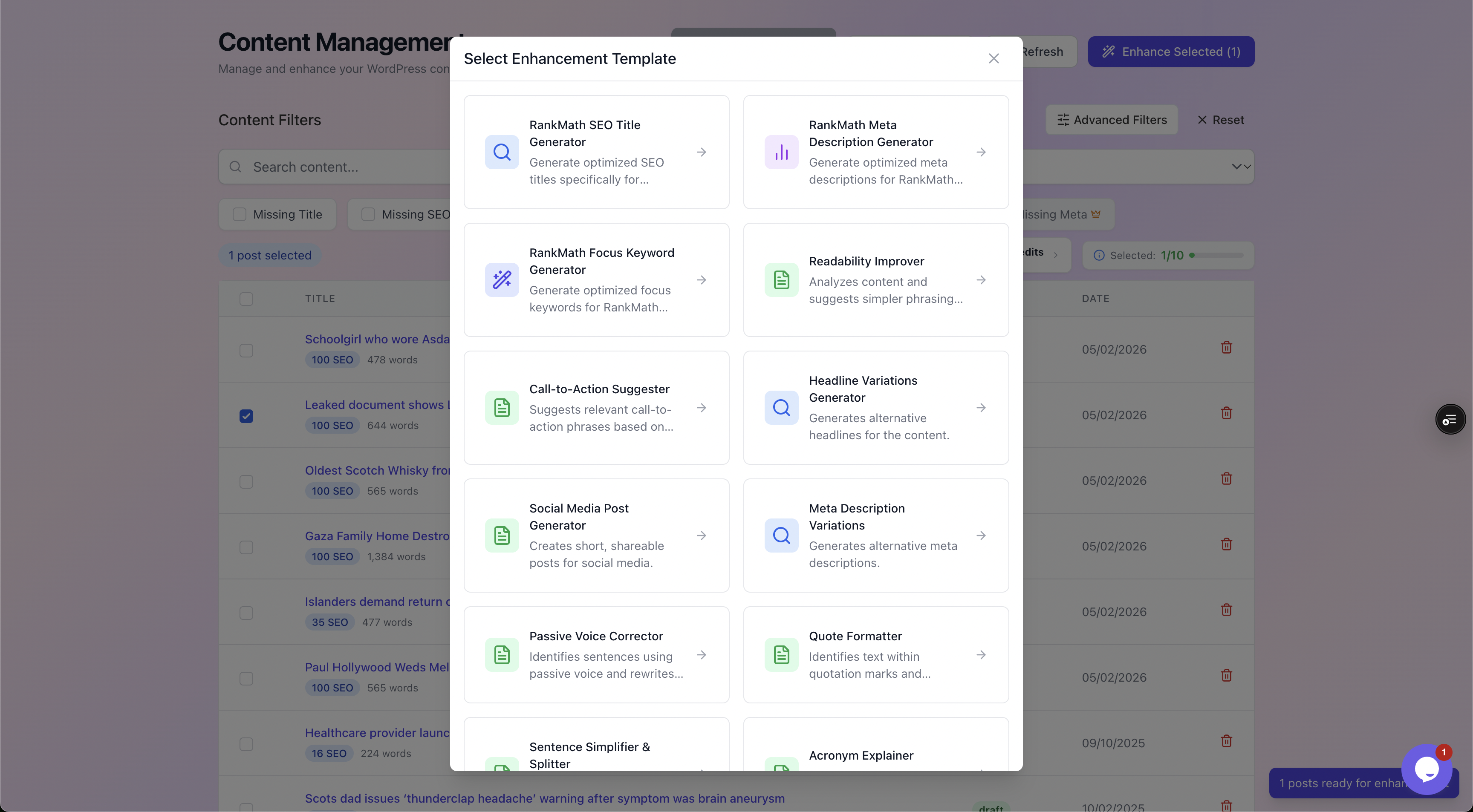
Dedicated generators for SEO titles, meta descriptions and focus keywords, plus readability fixes, CTA suggestions and headline variations, all writing back into your existing plugin.
The library covers the repetitive on-page work:
- A Rank Math SEO Title Generator
- A Meta Description Generator
- A Focus Keyword Generator
- A Readability Improver
- A Call-to-Action Suggester
- Headline and meta description variations
- Image alt text
The same generators write to Yoast and AIOSEO fields too, so the choice of SEO plugin never locks you out.
Worked example: a post with no meta description
Take a typical orphaned post. It has decent content, a focus keyword that was never set, and no meta description, so Google grabs a stray sentence from the body and the search snippet reads like nothing in particular.
Run it through the Meta Description Generator and you get a suggestion sat next to the original, scored against length, keyword presence, call to action and active voice.
Before:
(empty, Google picks a random line of body text for the snippet)
After:
Compare Rank Math, Yoast and AIOSEO on price, schema and keyword limits, then see how to fill in the metadata across every post in minutes.
That is 137 characters, leads with the keyword, has a reason to click, and reads like a human wrote it. Crucially, nothing is saved yet.
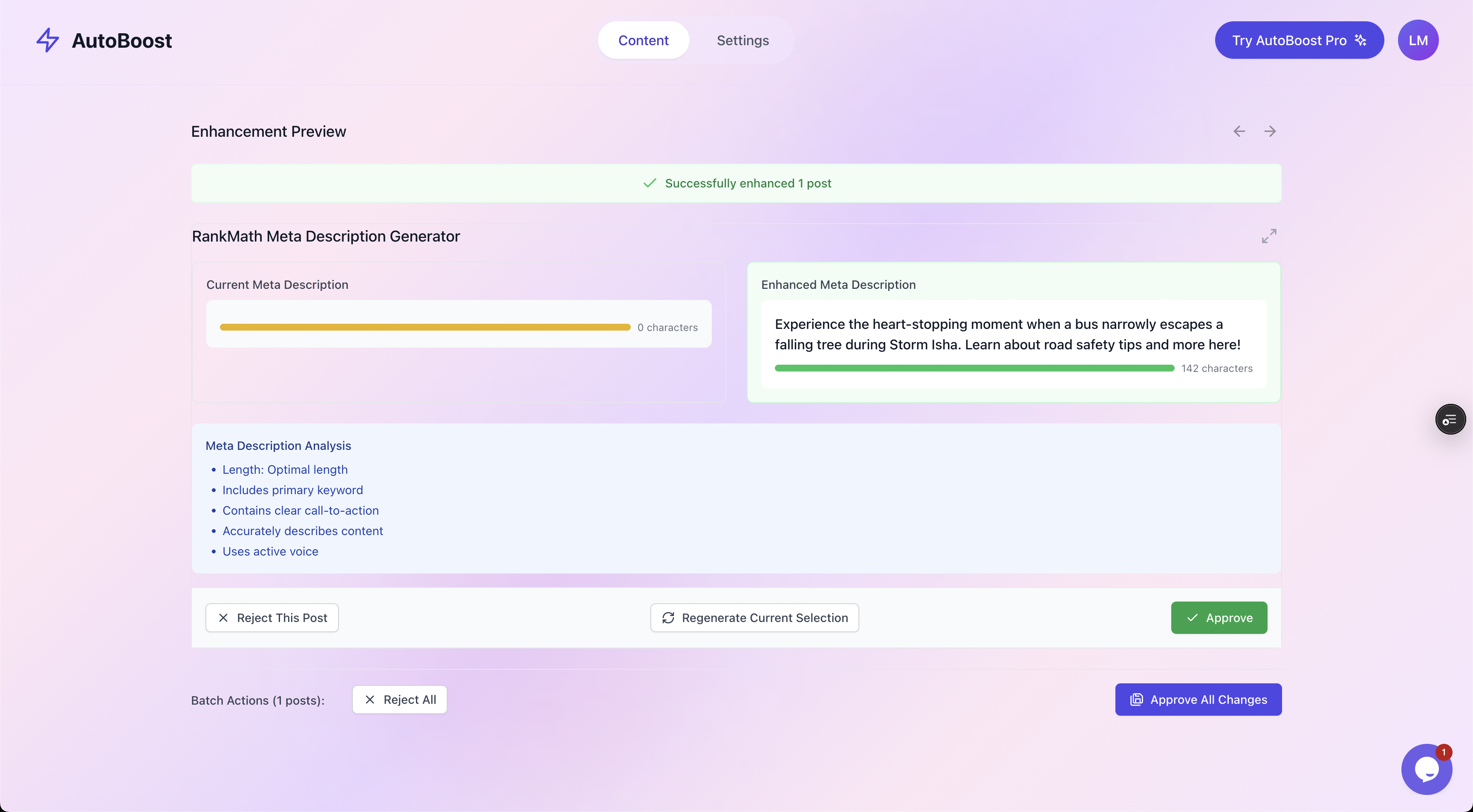
Every suggestion is shown against the original with a quality check, and you approve, reject or regenerate it. Nothing publishes until you say so.
That review step is the whole point. Human-in-the-loop is non-negotiable.
AutoBoost generates, you approve, and only approved changes are written back to your plugin. You keep editorial control over every page, which is what keeps automation safe and on-brand.
Honest limits: what an automation layer will not do
Same fairness we applied to the plugins applies here. Automation handles the repetitive on-page metadata. It does not handle content quality or backlinks.
- It will not make thin content rank. If a page does not answer the query, a better meta description will not save it. Rewrite the page.
- It will not earn you backlinks or build domain authority. That is off-page work.
- It is not a replacement for your SEO plugin. Rank Math, Yoast and AIOSEO still own your sitemaps, schema config and on-page analysis. AutoBoost fills them in.
- It still needs your review. The generated text is good, but you check it before it goes live, for accuracy and for voice.
For the bigger picture on doing this well, see our explainer on auto SEO for WordPress and the end-to-end WordPress SEO automation workflow.
Beyond fixing existing posts
On the Pro tier and above, AutoBoost can also generate new SEO-optimised content from a topic, keywords, tone and target audience.
That means the automation layer covers both the back catalogue and what you publish next. It is content creation with the same approval step, not a firehose of unreviewed posts.
Frequently asked questions
Is Rank Math better than Yoast in 2026? Rank Math offers more in its free tier, including up to five focus keywords per post and extensive schema, and uses per-account pricing that suits multi-site owners. Yoast is the more polished, beginner-friendly option with the deepest pool of learning resources and support. Neither is objectively "better"; Rank Math wins on free features and value, Yoast wins on ease of use and track record.
What is the best WordPress SEO plugin overall? There is no single best for everyone. For beginners, Yoast. For bloggers and value, Rank Math. For WooCommerce and local SEO, AIOSEO. All three are reliable, well maintained and capable. The deciding factor is usually your pricing model (per site vs per account), your need for ecommerce schema, and how many keywords you want per post.
AIOSEO vs Yoast: which should I choose? Choose AIOSEO if you run a WooCommerce store or need strong local SEO, as its ecommerce and local-business modules are excellent. Choose Yoast if you want the friendliest interface and the most beginner guidance. Both are mature plugins; the difference is emphasis rather than quality.
Can I switch SEO plugins without losing my data? Mostly yes. Rank Math, Yoast and AIOSEO all include import tools that migrate your existing titles, descriptions and keywords from a competitor. Always back up your database first and spot-check a handful of posts after importing, because not every custom field maps perfectly across plugins.
Do I still need an SEO plugin if I use AutoBoost? Yes. AutoBoost works with Rank Math, Yoast or AIOSEO, it does not replace them. Your SEO plugin owns your sitemaps, schema configuration and on-page analysis. AutoBoost scans your posts, generates the missing metadata in bulk, and writes it back into whichever plugin you use, with you approving every change first.
Whichever plugin you land on, the metadata still has to get filled in. See how AutoBoost optimises a whole WordPress site in minutes, writing into Rank Math, Yoast or AIOSEO with you approving every change, or check the pricing and post limits to find the right tier.