White-Label SEO: Deliver WordPress SEO at Scale
By AutoBoost Team · 2026-06-22 · 11 min read
White-label SEO is one of those phrases that sounds like a clever business model and quietly turns into a quality-control headache.
The promise is simple: you sell SEO under your own brand, someone or something does the work behind the scenes, and you keep the margin.
The reality is that whatever you put your name on still has to be good, because the client is judging you, not your hidden supplier.
This guide is for agencies and freelancers who manage SEO across many WordPress sites and are deciding how to deliver it:
- In-house, keeping every step under your own roof.
- Fully outsourced to a white-label fulfilment partner.
- Hybrid, systemised tooling plus your own judgement.
We will define what white-label actually means, show where it earns its keep and where it bites, and walk through how a tool plus a human review step lets you ship consistent on-page work under your brand without hiring a department.
Key takeaways
- White-label SEO means the client sees only your brand. Whatever runs behind the scenes, tools or fulfilment partners, is invisible to them and is still your reputation.
- Keep strategy, keyword targeting and the client relationship in-house. Systemise the repetitive on-page work: meta descriptions, SEO titles, focus keywords, alt text and schema.
- The hybrid model usually wins: your judgement on the front, automation on the grunt work, a human approval step in the middle so nothing reaches a client site unreviewed.
- White-label tools protect margin better than white-label fulfilment, because you keep control of quality instead of renting it.
What white-label SEO actually means
White-label SEO is reselling. You package a service, put your logo on it, set your own price, and the customer never sees who or what did the underlying work.
It comes in two flavours that often get muddled.
White-label fulfilment
You hire a third-party agency or contractor who delivers the actual SEO work and reports back to you. That work typically includes:
- Audits.
- Content.
- Link building.
- On-page fixes.
The results usually arrive in unbranded documents you can re-skin. You add a margin and present it to the client as your own. You are essentially a reseller of someone else's labour.
White-label tooling
You use software that does part of the work and either runs under your brand or sits invisibly in your process. The client never logs into it or sees its name.
You keep the relationship and the judgement; the tool removes the manual grind. AutoBoost's Enterprise tier sits here, and we will come back to it.
Why the distinction matters
The two carry very different risks:
- Renting labour means renting quality control and hoping the partner cares about your client as much as you do.
- Renting a tool means you keep control and just remove the bottleneck.
For repetitive on-page SEO at scale, tooling is almost always the safer trade.
What to keep in-house versus what to systemise
The single most useful decision you can make is drawing a clear line between the work that is your value and the work that merely takes time.
Get this wrong and you either burn margin doing low-value tasks by hand, or you outsource the very thing clients are paying you for.
Keep in-house
Anything that requires context about the client, their market, their goals or their voice:
- Keyword and topic strategy. Which terms are worth chasing and which are vanity.
- Competitive analysis and positioning.
- Content strategy, tone and editorial judgement.
- The client relationship, reporting narrative and expectation-setting.
- Technical architecture decisions and anything that could break the site.
Systemise
The repetitive, rule-based, high-volume work that has a right answer once you know the target keyword:
- Writing meta descriptions across hundreds of posts.
- Filling in missing SEO titles.
- Assigning focus keywords where none exist.
- Generating image alt text in bulk.
- Adding structured data and schema.
That second list is where agencies haemorrhage hours. It is genuinely necessary work, it moves rankings, and it is mind-numbing to do by hand across a 600-post client site.
It is also exactly the kind of work that automation handles well, because the judgement happens once, when you set the keyword and the brief, not 600 times. Our WordPress SEO automation workflow goes deeper on building that production line.
Tip: If a task needs the client's strategy to do well, keep it. If it just needs the target keyword and a consistent format, systemise it. That one question sorts almost everything.
In-house vs white-label vs hybrid
There is no universally correct model. There is a correct model for your size, your margin targets and how much control you can stand to give up.
Here is the honest comparison.
| Factor | In-house | White-label fulfilment | Hybrid (tools + your judgement) |
|---|---|---|---|
| Quality control | Highest, you own every step | Lowest, you rent it from a partner | High, you review before anything ships |
| Margin | Squeezed by labour cost | Squeezed by partner markup | Best, automation cuts the grind not the price |
| Scalability | Limited by headcount | High, but quality varies | High, capacity scales without hiring |
| Speed to deliver | Slow, manual work | Variable, depends on partner queue | Fast, bulk work in hours not weeks |
| Client risk | You carry it, but you control it | You carry it, partner controls it | You carry it, and you keep control |
| Best for | Boutique agencies, premium pricing | Agencies scaling fast, lower-touch clients | Most agencies managing many WordPress sites |
The trap with pure fulfilment
The problem with pure white-label fulfilment is that you are accountable for work you did not do and cannot fully see.
When a partner ships a generic meta description that misreads the client's product, the client emails you, not them. You are the brand on the invoice.
That is fine when the partner is excellent and terrible when they are average, and you rarely know which until a client is unhappy.
Why the hybrid model sidesteps it
The hybrid model keeps you in control at every risky point:
- You keep the strategy and the relationship.
- You let a tool do the repetitive on-page work in bulk.
- You keep a human review step, so nothing reaches a client site without your eyes on it.
You get the scalability of outsourcing without renting your quality control to a stranger. For most agencies running SEO across many WordPress sites, this is the model that holds up.
How automation plus a review step delivers under your brand
The reason on-page SEO at scale feels impossible by hand is volume, not difficulty.
Each individual meta description is easy. Writing 600 of them, consistently, in a client's voice, while juggling four other accounts, is what breaks. Automation flips the maths: it does the volume, you do the judgement.
Connect and scan
Here is how it works in practice with AutoBoost. You connect a client's WordPress site using the AutoBoost connector plugin and an Application Password, the same credentials your team already understands.
AutoBoost scans the site and surfaces exactly what is missing:
- Posts with no focus keyword.
- Posts with no SEO title.
- Posts with no meta description.
No more crawling spreadsheets to find the gaps.
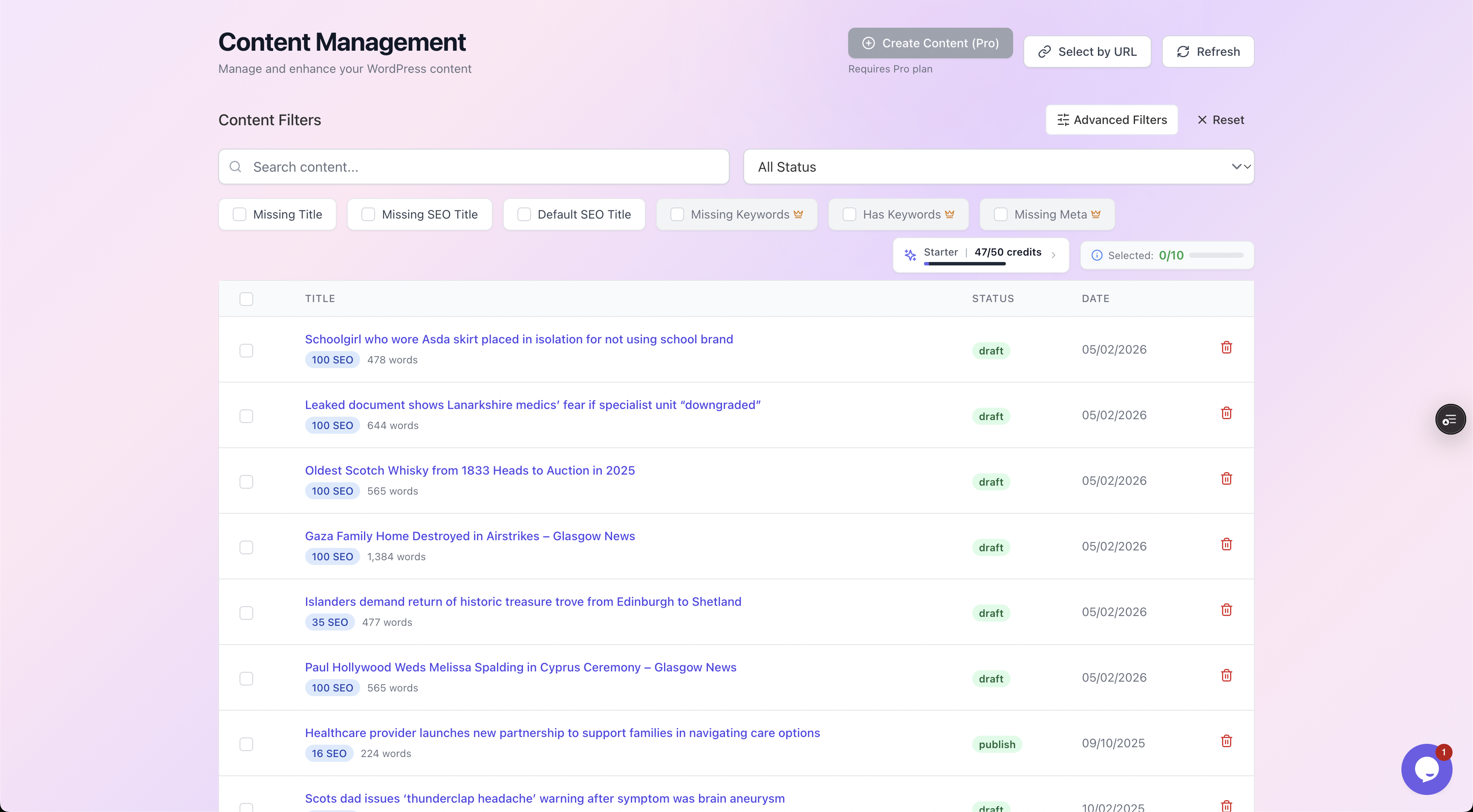
Filter a client site down to exactly the posts missing a focus keyword, SEO title or meta description, so you only spend time where there is a gap.
Bulk-generate into the client's stack
From there you pick an enhancement template for the field you want to fix and let AutoBoost bulk-generate optimised meta descriptions, SEO titles, focus keywords, image alt text and schema.
It writes the results straight back into whatever SEO plugin the client already runs, RankMath, Yoast or AIOSEO.
It works with their stack rather than replacing it, which matters enormously for client work: you are not asking a client to switch plugins or risk a migration.
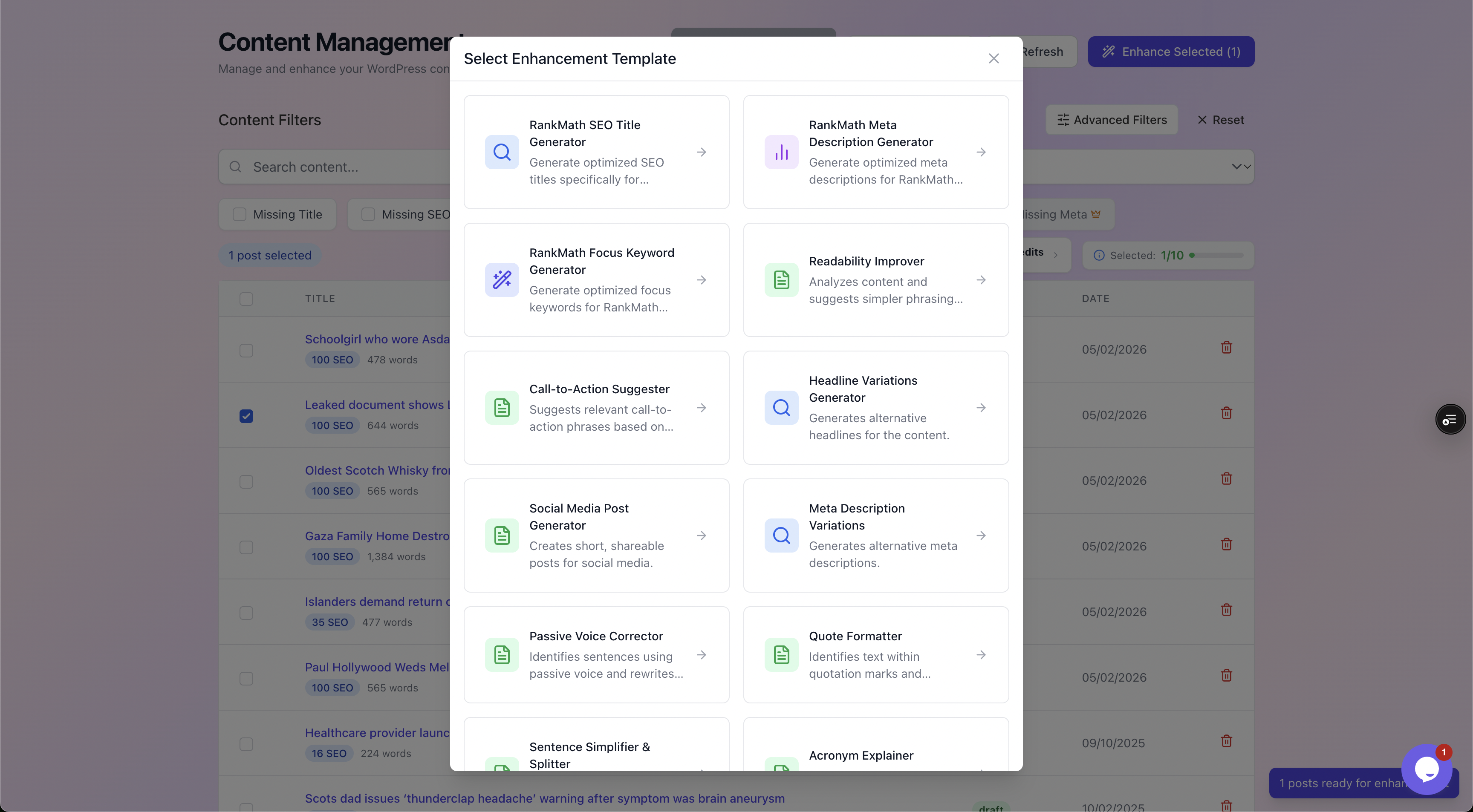
Choose the field to fix, then generate it in bulk. The same template applies a consistent format across every post on the client site.
The review step that makes it safe
The part that makes this safe for white-label delivery is the review step. Nothing publishes until you approve it.
AutoBoost shows you the current value and the proposed enhanced value side by side, with a quality checklist, and an Approve or Reject decision on each one.
For client work this is not a nice-to-have, it is the whole point. You are putting your brand on the output, so you read it before it ships.
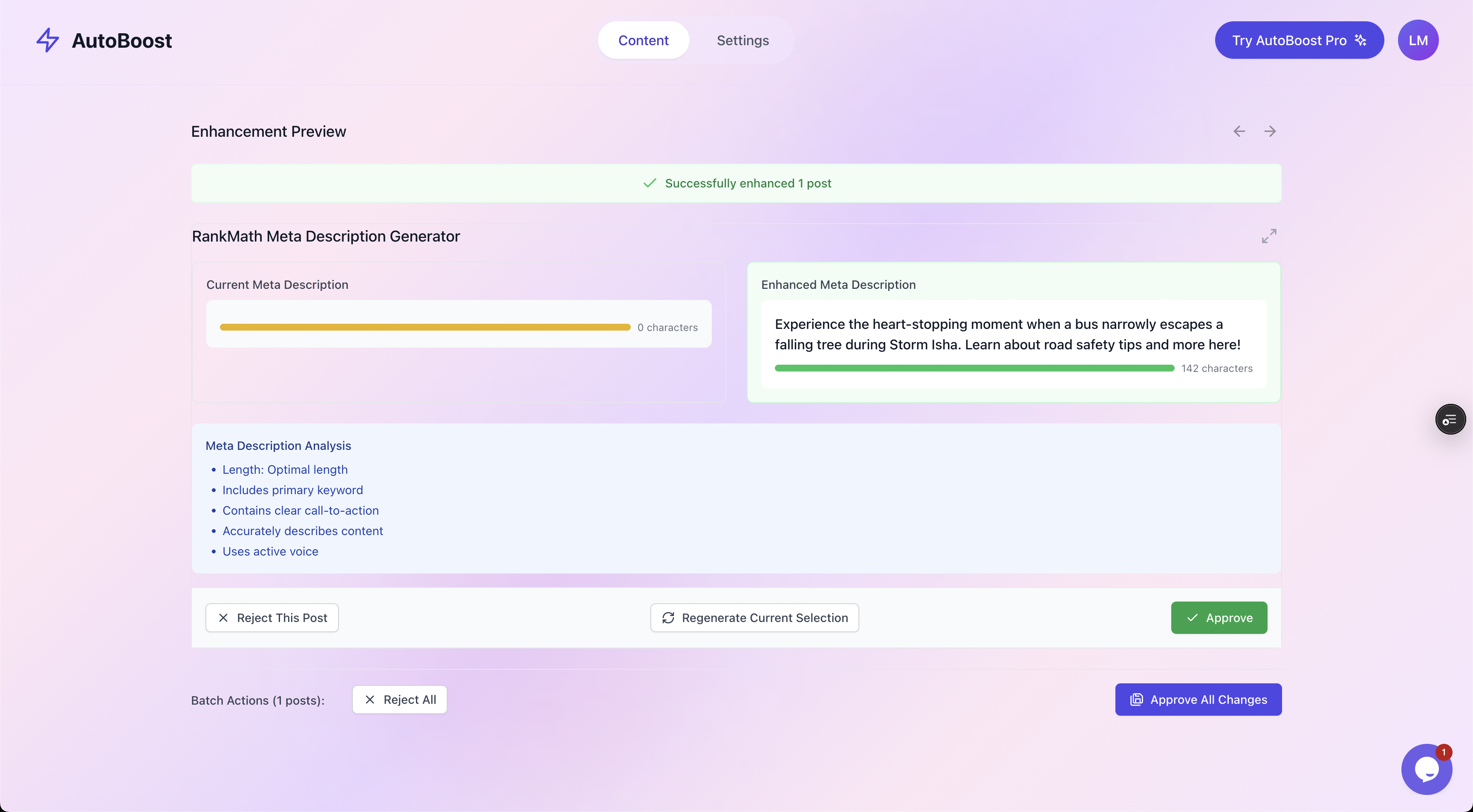
Current versus enhanced, side by side, with Approve or Reject on every item. Nothing reaches the client site without your sign-off.
This is the difference between automation and recklessness. The machine drafts; you decide.
A junior on your team can run the generation across a client site in an afternoon, then a senior reviews and approves in a single sitting. The grind is gone, the judgement stays human, and the client only ever sees polished, on-brand metadata appearing on their site.
Warning: Automation handles repetitive metadata. It does not write your content strategy, fix thin pages, earn backlinks or replace your account management. If you sell white-label SEO as "the tool does everything", you will under-deliver. Sell it as "we systemise the grind so we spend our hours on the work that actually needs us".
A worked example: onboarding a 600-post client
Say a new client comes through your agency with a content-heavy WordPress site. The state of it looks like this:
- 600 published posts.
- RankMath installed but barely configured.
- Roughly 70 percent of posts missing a meta description.
- Half missing a proper focus keyword.
- A few hundred images with no alt text.
A classic neglected blog. The kind of backlog that quietly suppresses rankings.
Why the old options fail
Neither traditional route serves you well here:
- Done entirely by hand, this is weeks of an SEO executive's time, and most of it is soul-crushing copy-paste. Priced realistically, the labour eats most of your margin.
- Outsourced to a white-label partner, you wait in their queue and pray the output understands the client's niche.
The hybrid approach, step by step
With the hybrid approach the same job looks like this:
- Connect and scan. Install the connector, add an Application Password, and let AutoBoost surface every gap. You know in minutes that 420 posts need a meta description and 310 need a focus keyword.
- Set the strategy in-house. Your SEO lead decides the keyword targeting for the priority posts, the ones actually driving or capable of driving traffic. This is the bit you keep, because it is the bit that needs to understand the client.
- Bulk-generate. A team member runs the meta description, SEO title, focus keyword and alt text templates across the backlog. The drafts arrive in a queue, consistently formatted, written against the targets you set.
- Review and approve. Your lead works through the before-and-after queue, approving the good ones, rejecting and re-running the few that miss. Because the format is consistent, this is fast, you are checking quality, not composing from scratch.
- Report under your brand. The client sees a properly optimised site and a clean before-and-after report with your logo on it. They never see the tool.
The work that took weeks becomes a couple of focused days.
Your margin survives because you did not throw bodies at copy-paste, and your quality survives because a human approved every line. That is white-label delivery done honestly.
For the recurring side of this, our guide on managing SEO across multiple WordPress sites covers keeping all your client sites maintained, not just onboarded.
Protecting quality and margin when you resell
A few principles keep white-label SEO from turning into a complaints inbox.
Never ship unreviewed work. The fastest way to lose a client is to let generic, auto-generated metadata reach their live site under your brand. The review step is not optional overhead, it is the thing that justifies your fee. Approve before publish, every time.
Standardise your output. Consistency is what makes a client feel they are dealing with professionals. Reusable templates mean every post on a site, and arguably every client, gets metadata in the same considered format. That consistency is far easier to hold with tooling than with a rotating cast of freelancers.
Keep the relationship and the strategy yours. The moment you outsource the thinking, you become a reseller with no defensible value. Outsource the typing, never the judgement.
Price for the value, not the hours. When automation cuts a two-week job to two days, do not slash your price to match the reduced effort. You are selling the outcome and your expertise, not your keystroke count. The efficiency is your margin, that is the entire point of the hybrid model.
Match the tier to your volume. Agencies running SEO across many client sites need post capacity, not a starter plan. AutoBoost's Agency tier covers 30,000 posts, and the Enterprise tier adds white-label so the delivery sits cleanly under your brand. You can compare what each tier covers on the pricing page, and see the full toolset on the features page.
Tip: The efficiency automation gives you is meant to be margin, not a discount. Resist the urge to drop your price just because the job got faster.
If you are still weighing tools, our breakdown of the best auto SEO plugins for WordPress covers what actually matters when you are choosing something to run across client sites.
Our wider guide to SEO for agencies on WordPress sets out the operational side of running this as a service.
Frequently asked questions
What is the difference between white-label SEO and reselling SEO?
They are effectively the same idea. Reselling SEO is the broad term for buying or producing SEO work and selling it on at a markup. White-label specifically means the work carries no trace of its origin, so you can stamp it with your own brand. All white-label SEO is reselling, but white-label adds the requirement that the client sees only you.
Should I use a white-label SEO partner or a white-label tool?
It depends on what you are reselling. For strategy-heavy work like content campaigns or link building, a fulfilment partner can make sense if they are genuinely good and you vet them carefully. For repetitive on-page work like meta descriptions, titles, focus keywords and alt text, a white-label tool is almost always better. You keep control of quality, you scale without a partner's queue, and your margin is not eaten by someone else's markup.
Will white-label automation hurt quality on my client sites?
Only if you skip the review step. Automation that publishes blindly is risky on anyone's site, let alone a client's. The safeguard is human-in-the-loop: the tool drafts, you review the before-and-after for each item, and nothing publishes until you approve it. Used that way, automation raises consistency rather than lowering quality, because every post gets the same considered treatment instead of whatever an exhausted executive managed at 5pm.
Can I use AutoBoost as a white-label SEO tool for my agency?
Yes. AutoBoost connects to each client's WordPress site via the connector plugin and an Application Password, then bulk-generates metadata that writes back into their existing RankMath, Yoast or AIOSEO setup, with an approval step before anything goes live. The Agency tier covers 30,000 posts and the Enterprise tier adds white-label delivery so it sits behind your brand. See the pricing page for what each tier includes.
Does white-label SEO software replace my SEO team?
No, and you should be wary of anyone who claims it does. It replaces the repetitive typing, not the thinking. Strategy, keyword targeting, content quality, technical decisions and the client relationship all stay with your team. Automation just removes the bottleneck that stops a small team serving a lot of sites, so your people spend their hours on the work that actually needs a human.
The honest bottom line
White-label SEO works when you are honest with yourself about what you are reselling.
Resell your judgement and your relationship and you have nothing defensible. Resell the outcome, keep the strategy in-house, and systemise the grind, and you have a model that scales without diluting quality.
For WordPress on-page work, the hybrid path is the strongest. It comes down to three moving parts:
- A tool that finds the gaps and drafts the fixes in bulk.
- Your team setting the targets and approving the output.
- The client seeing only your brand and a properly optimised site.
That is white-label delivery you can stand behind.
If you manage SEO across many client WordPress sites, take a look at the features and the Agency and Enterprise tiers on the pricing page.
The grunt work is the part you can hand off. The judgement is the part that keeps you in business.